What does a Physician Scientist do, and how do they combine clinical care and laboratory research? Daniele Canarutto describes his career at SR-Tiget.
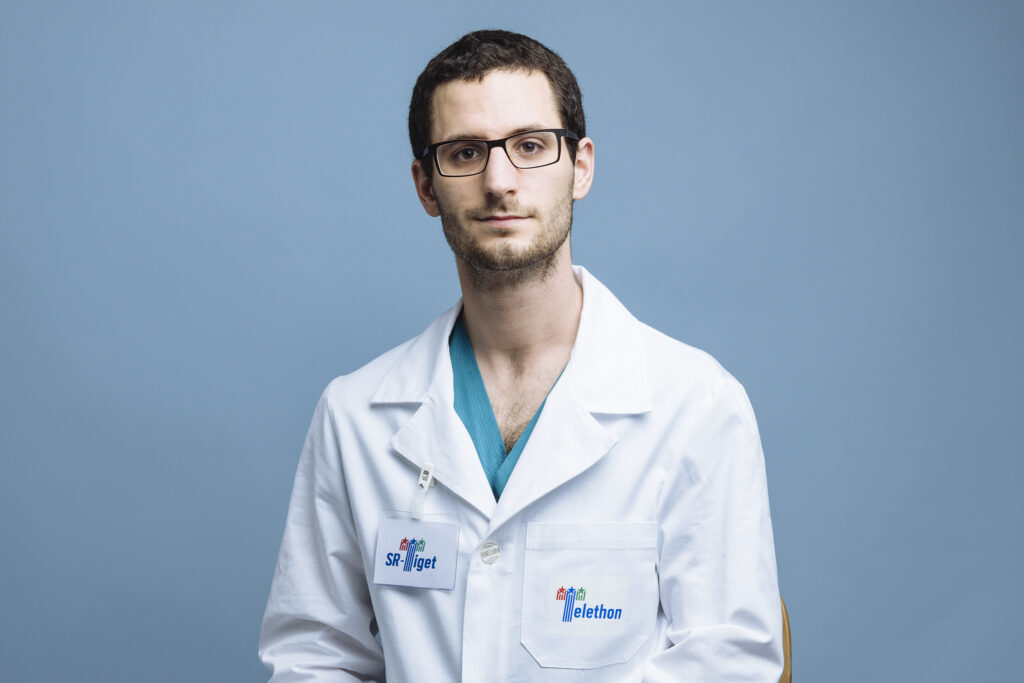
Caring for patients or working in a laboratory? For a Physician Scientist, these two paths are not alternatives, but complementary parts of the same professional career. It is still a relatively rare role, combining clinical practice with experimental research and supporting the development of new therapies from the laboratory to patients.
At the San Raffaele Telethon Institute for Gene Therapy in Milan, this role has been formalised through a dedicated career pathway comprising two positions: Physician Scientist Project Leader and Physician Scientist Group Leader. Among the professionals who have followed this pathway is Daniele Canarutto, a paediatrician and Physician Scientist Project Leader in the laboratory led by Luigi Naldini.
From a medical degree to laboratory research
Canarutto graduated in medicine from the University of Pisa in 2014. His interest in gene therapy then brought him to Milan, where he began his specialist training in paediatrics. During his final year, he also started a PhD, which he completed in 2023.
“My PhD focused on the clinical translation of a new gene therapy project for X-linked hyper-IgM syndrome, based on an innovative genetic manipulation technology” he explains.
His work was not limited to studying the biological efficacy of the treatment in the laboratory. Since the approach was also technologically novel, further studies were needed to assess the efficacy and safety of the new technology, address the regulatory aspects and help define the manufacturing process for the potential medicinal product.
In the following years, Canarutto worked with a multidisciplinary team to develop the clinical protocol, taking the project from its initial experimental stages towards future testing in people.
It is precisely this continuity that defines the role of a Physician Scientist: rather than focusing on a single stage, they understand the entire pathway leading from a scientific hypothesis to its potential clinical application.
A bridge between the laboratory and patients
Today, Canarutto devotes around 70% of his time to research and the scientific supervision of laboratory activities, while the remaining 30% is dedicated to clinical work in outpatient clinics and hospital wards.
This division allows him to remain directly involved with both experiments and patients. The value of a Physician Scientist lies precisely in the ability to examine the same problem from both perspectives.
“When developing highly innovative medicinal products, it is essential to understand their entire lifecycle, from development through to patient access. Having an overall view makes it possible to take informed decisions and avoid mistakes” he explains.
A project may be biologically interesting, for example, but prove to have limited clinical value because better therapies already exist, because the potential side effects would be unacceptable, or because the treatment would be too demanding for patients.
The opposite problem can also occur: insufficient knowledge of a therapy’s biological and pharmacological characteristics may lead to it being managed inappropriately from a clinical perspective.
A Physician Scientist therefore plays a critical role in maintaining a continuous dialogue between laboratory and clinic, and from clinic back to laboratory. The needs and observations emerging from direct contact with patients can generate new scientific questions, while experimental findings can suggest diagnostic or therapeutic opportunities that deserve further investigation. This continuous exchange is one of the pillars of SR-Tiget’s work.
SR-Tiget’s integrated ecosystem
This role finds particularly fertile ground in an institute such as SR-Tiget, where basic research, preclinical development, regulatory expertise, advanced therapy development and clinical care coexist within the same ecosystem.
In the field of rare diseases, this integration has distinctive features. For many conditions, there are no established guidelines or universally recognised standards of care. Physicians often need to develop highly personalised diagnostic and care pathways.
However, the role of the Physician Scientist is not limited to rare diseases. The ability to connect biological mechanisms, patients’ needs and therapeutic development can also be highly valuable in oncology, haematology and many other areas of medicine. What makes the difference is the presence of a robust ecosystem capable of supporting research and translating its results into new applications.
For Canarutto, this career also offers a particular professional balance: “Clinical work and laboratory research involve different routines and challenges. Alternating between them makes it possible to balance the benefits and the more demanding aspects of both, and to take the best from each profession”.
Being a Physician Scientist, therefore, means not having to choose between patients and experiments. It means drawing on the expertise of both worlds to reduce the distance between a scientific discovery and a new therapeutic opportunity.
